During my daughter’s multiyear treatment plan for leukemia, we discovered a lot of secret hideaways. Safe places tucked away in a busy city full of dirt, grime, and germs. One of our favorite places we could visit and not have to worry quite as much about crowded spaces or exposing her to anything that would be dangerous to her compromised immune system, was the Cincinnati Art Museum.
It is perched atop a hillside in Mount Adams, with historic Eden Park on one side, and the city scape on the other. The museum is only a few minutes drive from the hospital and was situated nicely on our route to and from Children’s. We could finish a day of treatments and sneak in a quick visit as something special before heading home.
I’ve heard it said that the pages of a book can transport you to anywhere in the universe. An art museum is similar. The rooms of every exhibit are filled with paintings and sculptures that act like portals to other worlds. With just a few steps you can traverse the globe and travel centuries in time. In frames and on pedestals you can peek into the brilliant and complex minds of artist after artist.
Cincinnati’s Art Museum is magnificent to say the least. One hallway has you reliving the lives of ancient Greeks and gazing upon an Egyptian sarcophagus, then you go up a short flight of stairs and you are standing in the presence of a genuine Monet. From its architecture to its art, the museum is a fertile playground for a creative mind to wander.
Our family didn’t have a set rhythm or process when it came to exploring the museum’s labyrinthian halls. We just let Everly be an open range kid. For so much of her treatment we had to keep her separated from normal kid environments or experiences because they posed a danger to her. Not at the museum. We could allow her to explore to her heart’s content. Often she would just go where her feet and her eyes would take her. Eventually, she would run out of gas, and we would rest on one of the benches and talk about the art around us. That’s when we met Margaret.
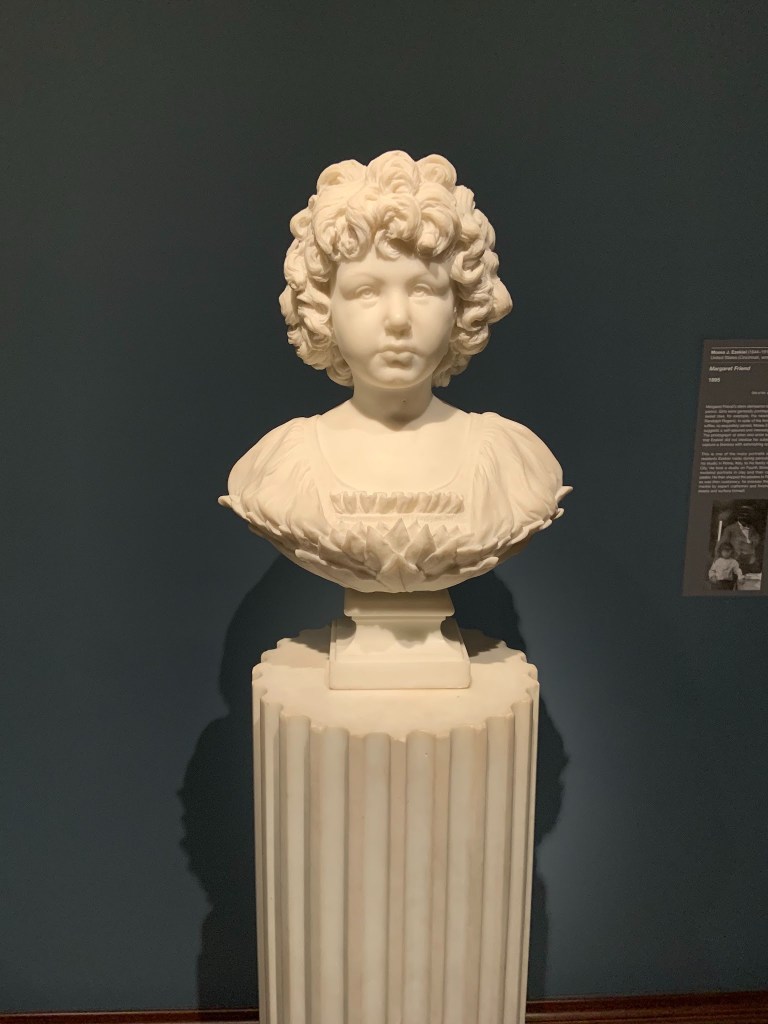
Her full name is Margaret Friend. I don’t know if that is her real name, or where she lived in Cincinnati, but I know she was real and she lived in Cincinnati. Margaret is a marble bust by the artist Moses J. Ezekiel. After we first discovered her we made sure to come by and visit her each and every visit. She is a beautiful sculpture to begin with but the allure she had with us was that she looked exactly like our Everly. From her tightly spiraling curls to the angle of her nose, the resemblance was uncanny.
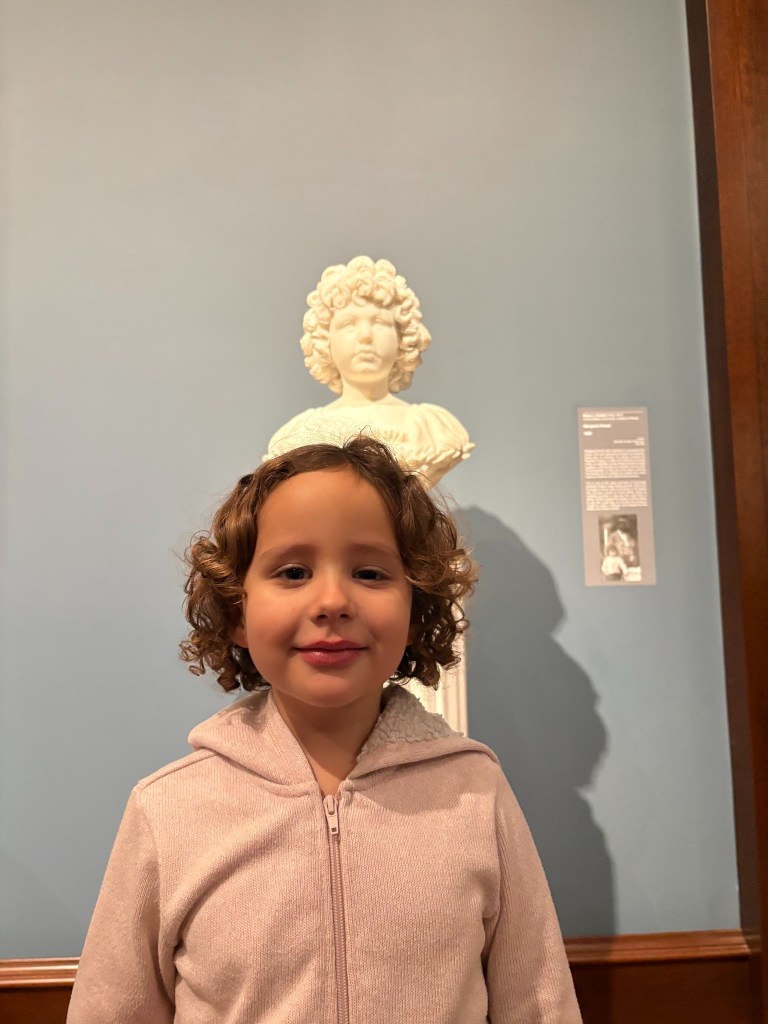
For my daughter, it was special to think that the museum had a sculpture of herself on display. When all of Everly’s hair began falling out, Margaret helped give us hope that her curls would someday return. For me though, I enjoyed pausing in front of Margaret’s statue and thinking about the unexpected journey that brought it to the place it was currently on display. Each time I sat with Margaret I learned another layer in her journey. I loved the description on the nearby plaque. It begins with, “Margaret’s stern demeanor is unusual for the period.” I guess children in art during that period were much more likely to be depicted as sweet instead of serious. I liked this girl Margaret, because my Everly was also always making serious faces at people.
Margaret’s sculptor, Moses Ezekiel, grew up in Richmond, Virginia. Born in 1844, he worked as a bookkeeper in a family shop. He showed talent as an artist and his aspirations took him to Europe where his skills and abilities continued to flourish. He eventually ended up starting his own studio in Rome, Italy. His work became quite prolific. I wonder where in his journey from Richmond to Rome he went from feeling more like a bookkeeper to feeling more like an artist?
His family ended up moving to Cincinnati. At some point, while spending time in Cincinnati with his family, he opened a studio on 4th street. That is where Margaret enters the frame. Moses would have sculpted her bust out of clay and carefully shipped it off to his other studio in Rome. Once there, he would have used it to sculpt the final piece out of marble.
The story of Margaret’s marble bust spans an ocean twice and multiple countries in transit. The art my daughter and I would gaze upon started off as Cincinnati clay, and became Italian marble. The stern demeanor of young Margaret frozen in time and on display for every passerby. That’s just the physical and tangible journey of the art. You can find Moses Ezekiel’s life journey several places online. It is complex and is woven through many important and painful moments in our nation’s history. I am curious though about Margaret’s story. How old was she when she sat in Ezekiel’s studio? What life experiences gave her that stern demeanor? Did she ever see her finished statue in Italian marble? How much time passed if she did? The plaque by this work of art says it was completed in 1895. I wonder if Margaret ever brought her children or grandchildren, even as late as the 1960’s or 70s’, to see her serious expression set in stone.
Great art moves us beyond reflection, upon the work itself, and makes us consider ourselves because of it. Do you like how I said that in a way that suggests that I know ANYTHING about art? Sitting in front of this masterfully sculpted piece would often make me think about my daughter and I. In the midst of her treatment, I wondered if and when we would get to see her beautiful curls again. As I would consider what the rest of Margaret’s life was like, I also considered what Everly’s might become. Would it be measured in decades? Would it be framed by cancer? Or would cancer be just a significant moment within a greater journey?
I didn’t just stop there, I also thought about myself. Would anything I say, do, or make, stand the test of time like this work of Moses Ezekiel? I felt a more kindred spirit with the art than I did the artist. As my years turn into decades, I feel more like I am Cincinnati clay being shaped into something new than I feel like Italian marble, exquisitely carved into a finished museum piece. I know I am being crafted, but I am all too aware that I am far from being put on display.
In the journey, I am thankful for places like the art museum, and for Margaret Friend, who any of us can sit with and consider a world of possibilities without holding on to any specific thought for too long. My daughter has finished her treatment. Her curls have returned. Soon, Margaret’s stern demeanor will only remind us of the little girl she was and the sometimes serious faces she would make at that age. I keep visiting Margaret though, and she keeps giving me new things to consider. If you see her at the museum, be sure to tell her Everly and I say hello.


Leave a Reply